



























Data Center Capacity Planning Anxiety is Rising in 2026. How DCIM Can Help.
Data center capacity planning concerns are growing.
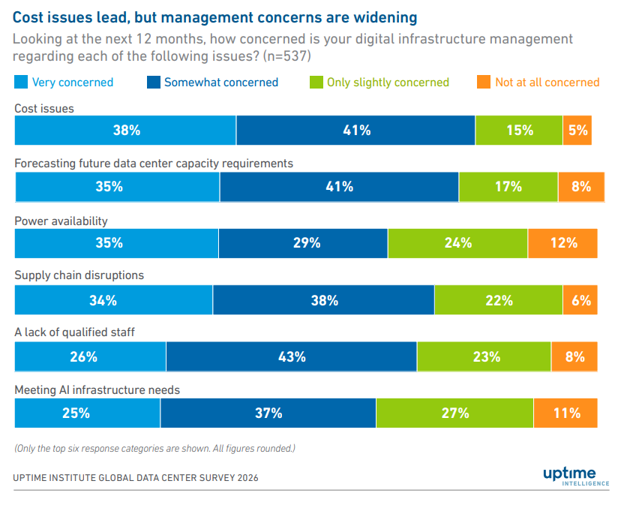
The Uptime Institute Global Data Center Survey 2026 reveals that the share of data center managers and operators who are at least somewhat concerned about forecasting future capacity requirements has risen from 68% in 2024 to 76% in 2026.
Data center professionals are caught between accelerating business demands, aggressive artificial intelligence rollouts, higher-density GPU clusters, and intense scrutiny over power and cooling. When uncertainty surrounds the scale, timing, and location of future demand, traditional capacity planning methods fall short.
In this blog post, you’ll learn how modern Data Center Infrastructure Management (DCIM) software helps data center teams overcome capacity planning anxiety and optimize utilization of their existing infrastructure.
The Root Causes of Data Center Capacity Planning Concerns in 2026
Forecasting capacity has become significantly more complex due to intersecting operational pressures. Uptime Institute’s data highlights several compounding factors driving management concern:
- Forecasting future requirements. 76% of respondents report concern over predicting capacity needs as high-density AI infrastructure and traditional workloads compete for resources. The modal rack density—the most commonly reported density—has surpassed 11 kW in 2026, up from 9 kW in 2025. At the same time, more operators are reporting peak rack densities of 30 kW or higher, adding another layer of complexity to power and cooling capacity planning.
- Power availability and cost constraints. While cost concerns remain dominant, power constraints and the growing demand for high-density power infrastructure create rigid ceilings on expansion. Operators are under intense pressure to maximize facility power capacity and contracted colocation power, making inefficient whitespace allocation increasingly costly.
- Interconnected operational bottlenecks. Shortages of qualified staff, supply chain delays for specialized equipment, and growing sustainability requirements mean operators cannot simply throw hardware at a capacity problem. When technology refresh timelines are tightening and hardware costs remain high, every kilowatt must be accounted for with precision.
The Cost of Getting Capacity Planning Wrong
Capacity planning decisions are only as good as the information behind them. When teams are working from outdated data or disconnected systems, even small planning errors can have significant operational and financial consequences.
Common challenges include:
- Capacity that cannot be used. A data center may appear to have available space, but that space may lack the power, cooling, connectivity, or other resources needed for a deployment. Without a complete view of available capacity, valuable resources can remain stranded and underutilized.
- Demand that outpaces available resources. If future requirements are underestimated, teams can run into capacity constraints when new equipment needs to be deployed. The result can be delayed projects, difficult deployment decisions, and increased operational risk.
- Higher infrastructure costs. Overestimating requirements can lead organizations to invest in capacity they do not immediately need. Underestimating them can force expensive, last-minute expansion. Both scenarios make it harder to get the most value from existing infrastructure.
Where Traditional Capacity Planning Methods Break Down
For many data center teams, capacity planning still depends on spreadsheets, manual updates, and information pulled from multiple systems. These approaches may have worked when environments were smaller and less dynamic, but they become increasingly difficult to manage as infrastructure grows more complex.
Several limitations make traditional planning approaches particularly challenging:
- Data becomes outdated quickly. Data center infrastructure is constantly changing. Equipment is installed, moved, repurposed, and retired, making manually maintained spreadsheets increasingly difficult to keep accurate. The more frequently the environment changes, the greater the risk that planning decisions are based on stale information.
- Critical information is spread across systems. Capacity-related data may reside in the CMDB, ticketing system, network management tools, server management platforms, and other systems. Because those systems are often disconnected, teams can struggle to understand the full operational impact of a planned change.
- Planning lacks a complete picture. Capacity is not simply a question of how much rack space is available. Power, cooling, connectivity, weight, and other constraints can determine whether a location is actually suitable for new equipment. Without centralized visibility into these factors, teams can spend significant time determining what capacity is truly available.
How DCIM Software Enables Better Capacity Planning Decisions
A more effective approach is to bring capacity information together and make it actionable. DCIM software gives data center teams a centralized view of their infrastructure so they can evaluate available resources, assess planned changes, and make deployment decisions with greater confidence.
Key capabilities include:
- Get more from existing capacity. Sunbird’s Auto Power Budget feature automatically establishes accurate power budgets for individual device instances based on their actual measured load. This gives teams a more precise view of how much power capacity is really available within existing racks. What-if analysis can also model the effect of adding equipment, helping teams determine whether planned deployments can be accommodated without adding infrastructure.
- Identify and reserve the right location faster. Equipment templates capture the deployment requirements associated with new equipment, allowing teams to search for cabinets that meet the necessary space, power, and connectivity requirements. Once a suitable location is identified, the required resources can be reserved together rather than managed separately.
- See capacity across the data center. Interactive 2D and 3D views provide visibility into rack capacity across factors such as space, power, cooling, and weight. Teams can identify underutilized resources, uncover capacity imbalances, and make better use of what is already deployed before committing to additional infrastructure.
- Understand power capacity across the environment. Sunbird DCIM provides visibility into power capacity and utilization across the modeled power infrastructure, from facility-level feeds through downstream distribution to IT equipment. This helps teams evaluate available power, understand load conditions, and make better-informed decisions about where additional equipment can be deployed while accounting for power and redundancy requirements.
Real-World Examples of Capacity Planning with Sunbird DCIM
Leading organizations are already using Sunbird DCIM to transform the way they plan and manage capacity. For example:
Comcast Achieved 40% More Usage from Existing Resources
Using Sunbird DCIM, Comcast gained visibility into assets, space, power utilization, and capacity throughout its facilities and power infrastructure. By combining this information with Sunbird’s Auto Power Budget capability, Comcast could determine more accurately how much power individual devices actually required and identify where additional equipment could safely be deployed.
Teams could also determine in advance where new assets should be connected, what downstream infrastructure would be affected, and how much power the deployment would consume.
Comcast reported getting 40% more usage from its facilities and power sources.
Cisco Consolidated Colo Cages In One Site by 66% to Save $40,000 Per Month
A lack of easily accessible information made it difficult for Cisco to determine how much of their contracted colo space and power was actually being used.
With Sunbird DCIM, Cisco modeled its colocation environments in dcTrack and gained a clearer view of equipment placement, power utilization, cabinet capacity, and the physical layout of each site.
That visibility gave Cisco a more informed way to plan deployments and consolidate its footprint. Teams could identify cabinets with available capacity, evaluate power requirements, and determine where equipment could be moved while remaining within their contracted power limits.
In one location, Cisco consolidated three colocation cages into a single cage, eliminating the recurring costs associated with the other two. The move saved $40,000 per month, and Cisco was pursuing four additional consolidation and migration efforts with similar savings potential.
Raxio Group Ditched 25 Spreadsheets for Real-Time Capacity Data
Raxio Group manages a growing portfolio of carrier-neutral data centers across Africa, where its operations teams previously relied on roughly 25 spreadsheets to track assets, power, and capacity across multiple sites.
With information distributed across teams and countries, it was difficult to maintain a reliable, current view of available resources.
With Sunbird DCIM, Raxio created a centralized digital twin of its data centers and gained visibility into capacity and utilization across its sites. Management dashboards show total and sold capacity, while more detailed views provide available power by row and aisle and track power trends. Raxio also models new tenant deployments against available capacity before equipment is installed, helping teams determine optimal placement based on space and power requirements.
This visibility allows Raxio to plan deployments more accurately, identify stranded capacity, and establish a timeline for when additional phases of its data centers will need to be brought online—while giving customers greater visibility into their own deployments.
Bringing It All Together
Capacity planning is becoming more challenging as data center environments grow more dynamic and demand becomes harder to predict. As AI infrastructure, higher-density deployments, and competing demands for space, power, and cooling continue to evolve, relying on static or fragmented capacity data creates unnecessary uncertainty.
The answer is not simply to build more capacity. It is to understand the capacity already available, identify where it can be used more effectively, and have the visibility needed to plan for what comes next. With Sunbird DCIM, data center teams get a digital twin of their infrastructure and a centralized, up-to-date view of capacity, helping them make more confident decisions about deployments, utilization, and future growth.
Ready to see how Sunbird DCIM can help you simplify and automate data center capacity planning? Get your free test drive now.