



















Why Communities Hate Data Centers and How DCIM Can Help
Across the United States, data center projects are being stalled, local governments are putting ordinances in place to limit data center buildouts, all because people hate data centers.
Due to community pushback, in Q1 2026 alone, over $130 billion’s worth of AI data center projects has been blocked or delayed.
Uptime Institute describes the current state of AI adoption and buildouts as “mildly apocalyptic”
Matt Stansberry, VP of Data Center Practitioner Insights & Experience for Uptime Institute, at a recent Sunbird Global User Group, described the state of AI adoption and buildouts as “mildly apocalyptic,” due to the increase in fear and misperceptions of data centers and their impact on communities. Much of this misperception comes from the rise of AI training and inferencing. Uptime Institute’s AI Infrastructure survey found that nearly two-thirds of respondents use the same infrastructure for training and inference.
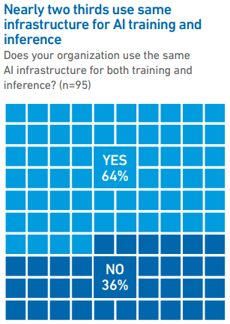
Source: Uptime Intelligence, AI Infrastructure Survey 2025.
To learn more about Uptime’s take on AI’s impact on data center operations, watch their on-demand webinar Five Data Center Predictions for 2026. If you would like to access other reports from Uptime, you can request an evaluation of Uptime Intelligence.
Why are communities against data centers?
- Symbolic of AI: Many communities view data centers as symbols of AI and oppose data centers due to their fear and distrust of AI. Despite the usefulness of AI and the fact that data centers are used for more than just AI workloads, people still see all data centers as AI data centers. AI is not only recently mainstream, but also perceived as disrupting the job market.
- Noise in residential areas: According to the New York Times, three lawsuits related to noise have been filed against data centers.
- Potential increases to electric bills: According to Fortune, data center power demand among mid-Atlantic/Midwest states has already led to $23 billion in electricity price increases.
- Potential increases to water bills: Concern over the amount of water used to cool data centers is also common, More data centers are moving away from fans and toward a hybrid-cooling solution that leverages liquid cooling, particularly closed-loop systems. The water used in a closed-loop system is recirculated continuously and not drained or evaporated off.
- Lack of transparency: Residents in NJ recently expressed anger and uncertainty over the obfuscation of information around a potential data center site.
How are legislators responding to data center pushback?
Many states and local jurisdictions across the United States have implemented legal limitations on data center buildouts, ranging from out-right bans to moratoriums and stricter limitations on incentives offered to qualifying data centers. For example:
- According to NCSL, legislators in 15 states are considering banning data center development.
- New Jersey recently passed a law requiring the NJ Board of Public Utilities to create a new electric rate for large-load data centers intended to ensure residents don’t have to pay for the power costs associated with operating the data centers.
- New Jersey has temporarily paused its benefits offered to AI data centers through the Next NJ program.
- Perhaps the most high-profile legislation in the United States is the Artificial Intelligence (AI) Data Center Moratorium Act, introduced by Representative Alexandria Ocasio-Cortez and Senator Bernie Sanders.
Opposition to data centers has certainly grown in the age of AI, but can data centers survive the apocalypse?
How can DCIM help your data center be a better neighbor?
DCIM is obviously not public relations or customer management software, but several of its features can help you address many of the reasons for community pushback against data centers:
- Reduce noise through liquid cooling: A liquid-cooled server is not only more energy and space-efficient than an air-cooled server, but also quieter than using a CRAC or a fan for every server. Whether you use direct-to-chip or rear-door heat exchangers, DCIM can help you manage your liquid cooling system.
- Reduce power consumption: DCIM provides outlet-level power monitoring, which can help you accurately calculate actual power usage.
- Improve transparency: DCIM's built-in analytics tools leverage real-time data to give stakeholders and customers visibility into operations.
Want to see how Sunbird’s second-generation DCIM software can help you optimize your data center operations? Get your free test drive today!